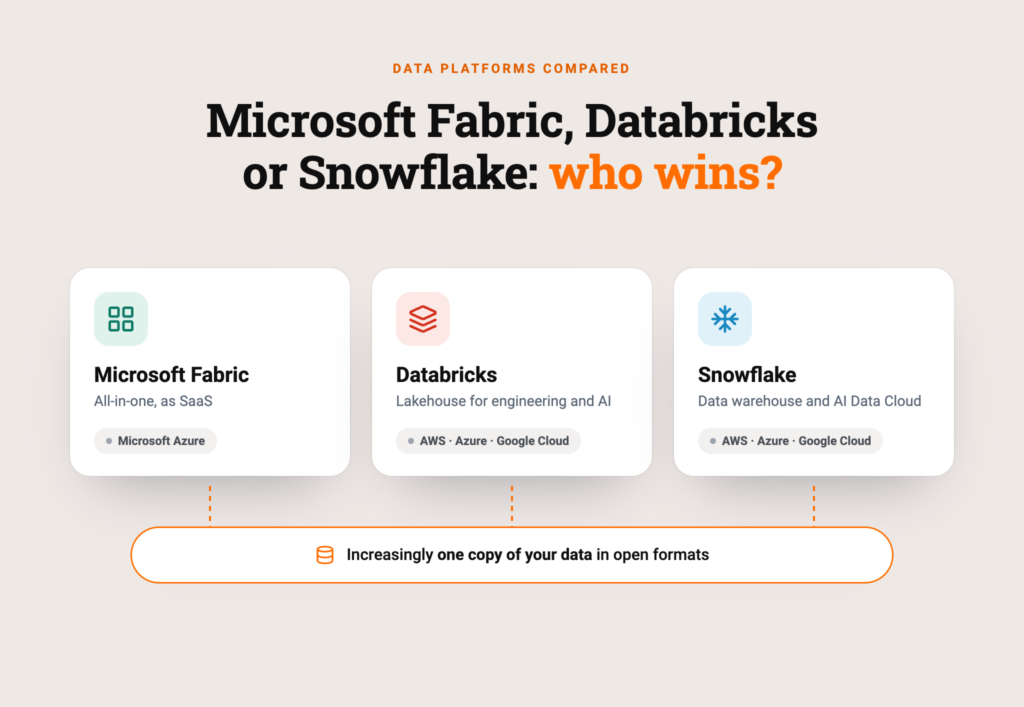












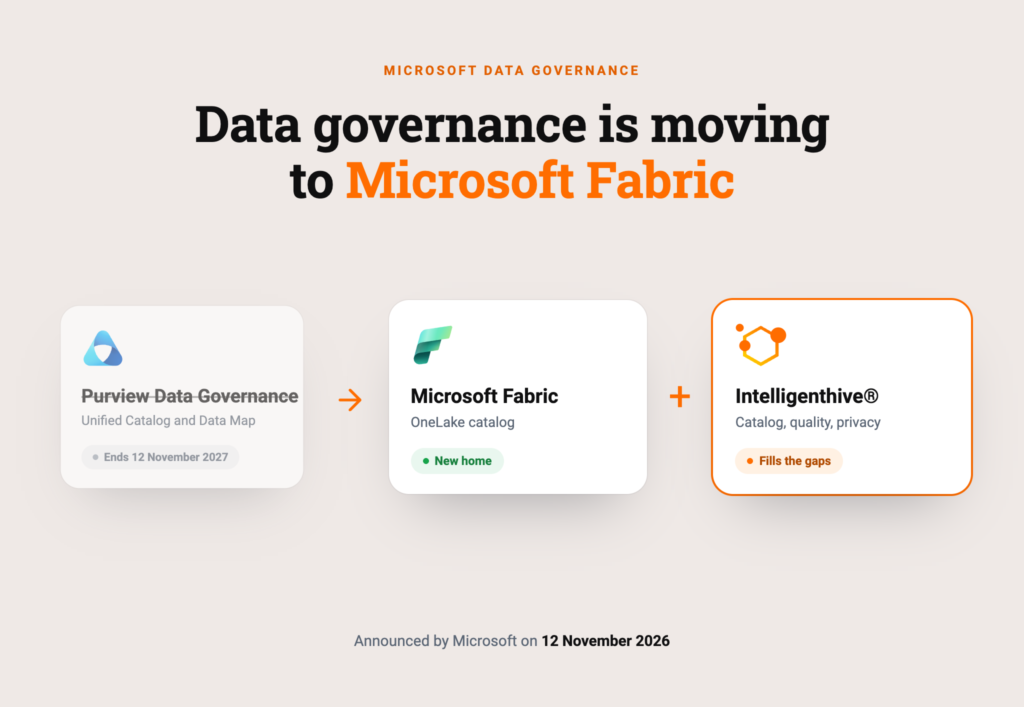
On 12 November 2026, Microsoft announced a notable decision. Purview Data Governance is being retired. Data governance gets a new home: Microsoft Fabric, with the OneLake catalog as its foundation. Microsoft sums it up itself: “What’s changing is not our commitment to governance, it’s where that governance lives.”
Do you use Purview for your data catalog, your glossary or your data quality? Then the clock is now ticking. For us, the announcement came as no surprise.
What has Microsoft announced?
The essentials in four points:
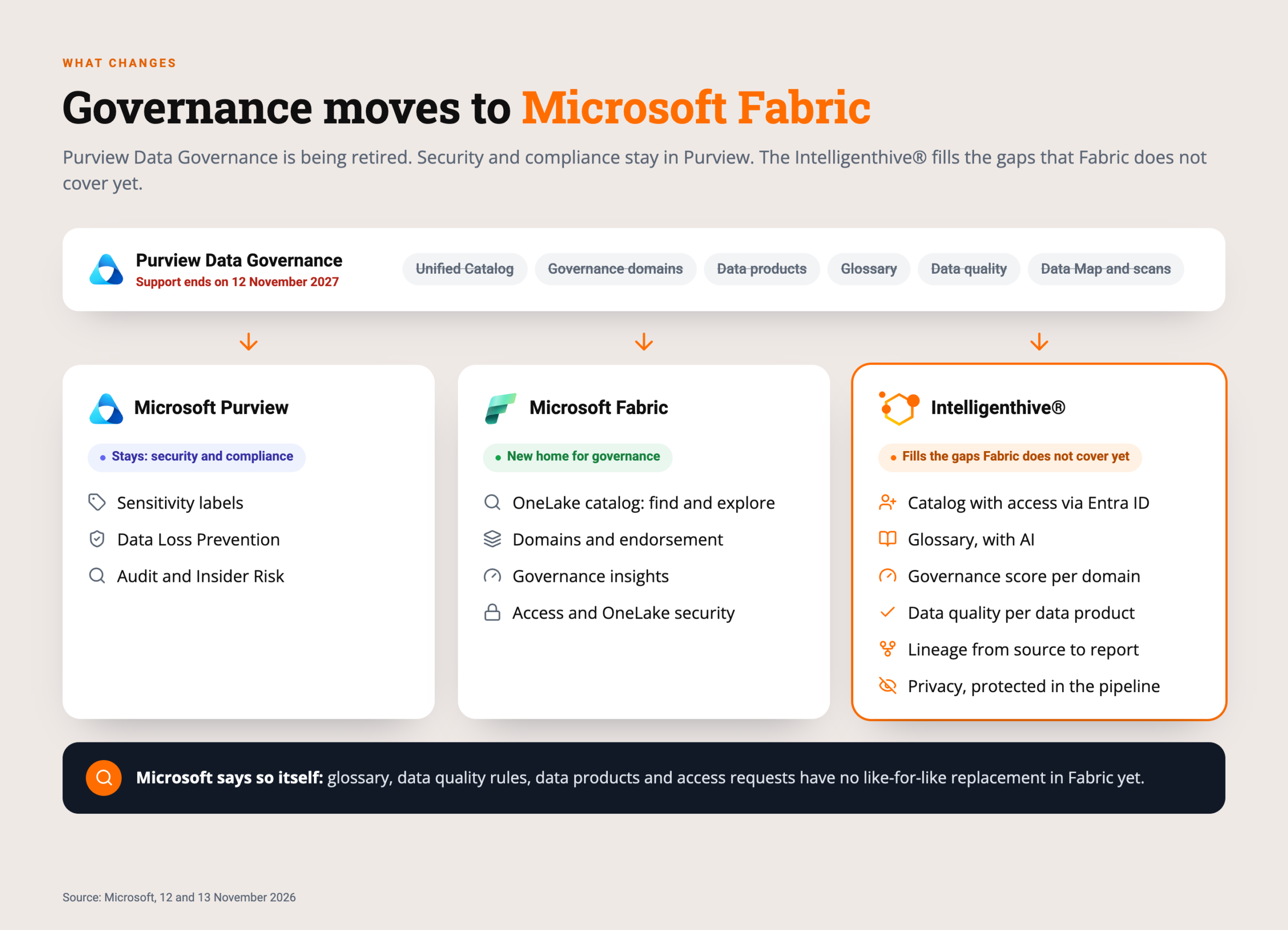
- Microsoft Fabric is now the data governance solution. The OneLake catalog becomes the place where you find, govern and secure data, including data outside OneLake that you bring in through shortcuts or mirroring.
- Purview Data Governance will be retired in a year. New accounts can no longer be created. Existing environments stay in maintenance mode until 12 November 2027: they keep working but get no new features. After that, support ends.
- It is the governance half of Purview. Unified Catalog is retired, including governance domains, data products, glossary, critical data elements and data quality. The Data Map with its scans and the classic Azure Purview features go too.
- Security and compliance stay in Purview. Sensitivity labels, Data Loss Prevention, audit and Insider Risk Management remain and also protect your Fabric data.
On top of that, governance in Fabric is included in your Fabric capacity. You no longer pay separate meters for it.
What does this mean for you?
You have twelve months. Map out what you have built in Purview now: domains, data products, glossary terms, quality rules, owners and the links with other systems. The sooner you know what you rely on, the smoother the move.
Governance moves closer to your data. That is good news. A label, a policy or a piece of lineage no longer has to travel back and forth between two systems. And AI agents work with the same permissions, labels and lineage as your data itself. Anyone who is serious about AI needs exactly that.
Not everything has a place in Fabric yet. Microsoft says so itself, in its transition guide of 13 November. The OneLake catalog is strong at finding and exploring data, domains, endorsement, lineage for supported items and an overview of who can access what. But a full glossary, critical data elements, data quality rules with a score and a complete process for access requests have no like-for-like replacement today. For data products, Microsoft advises arranging the owner, quality and access process alongside the catalog where needed.
Leave security where it is. You don’t need to move sensitivity labels and DLP policies. They stay in Purview and keep protecting your Fabric data.
Working in a regulated sector? Microsoft asks organisations with contractual obligations or in highly regulated industries to contact their Microsoft account team early.
We saw it coming
Purview was powerful, but also complex. It was built for data stewards and specialists, not for the colleague who simply wants to know where the revenue figures per customer are. At the same time, Fabric grew fast and more and more governance ended up in the platform itself. Two systems solving the same problem: a choice had to be made.
That is why we have been preparing for this shift since early 2026. We are taking over features from Purview in the Intelligenthive®. Where Fabric is strong, we build on Fabric: OneLake security, workspaces, domains and endorsement. What neither Fabric nor Purview handled well, we add. Always based on what our customers told us. A few examples.
A data catalog as a storefront, in your own brand
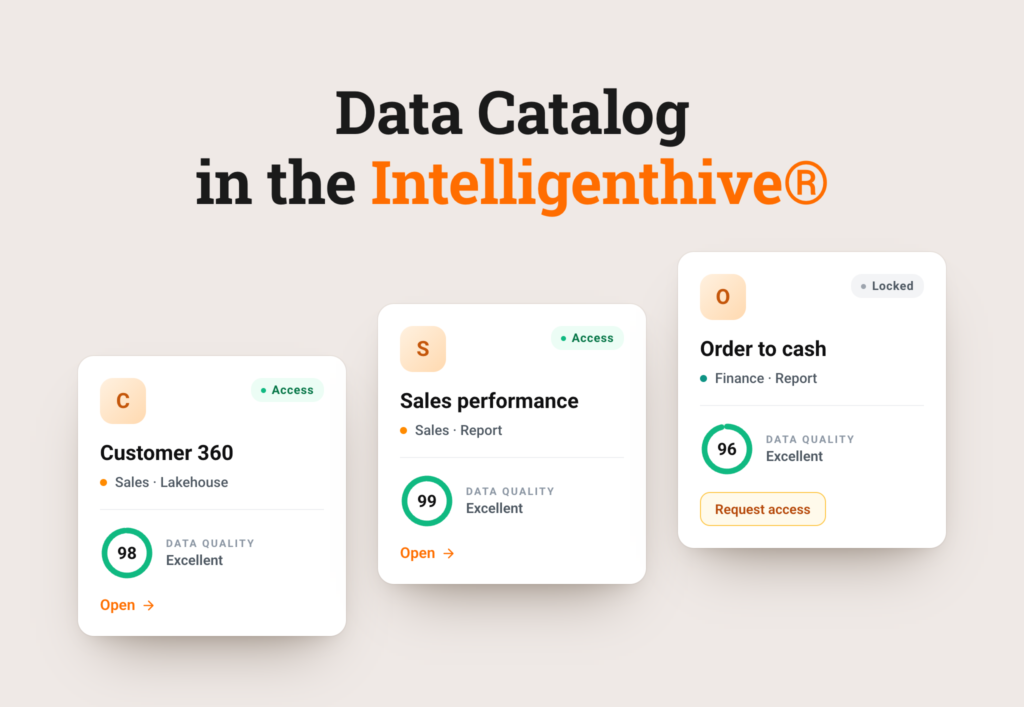
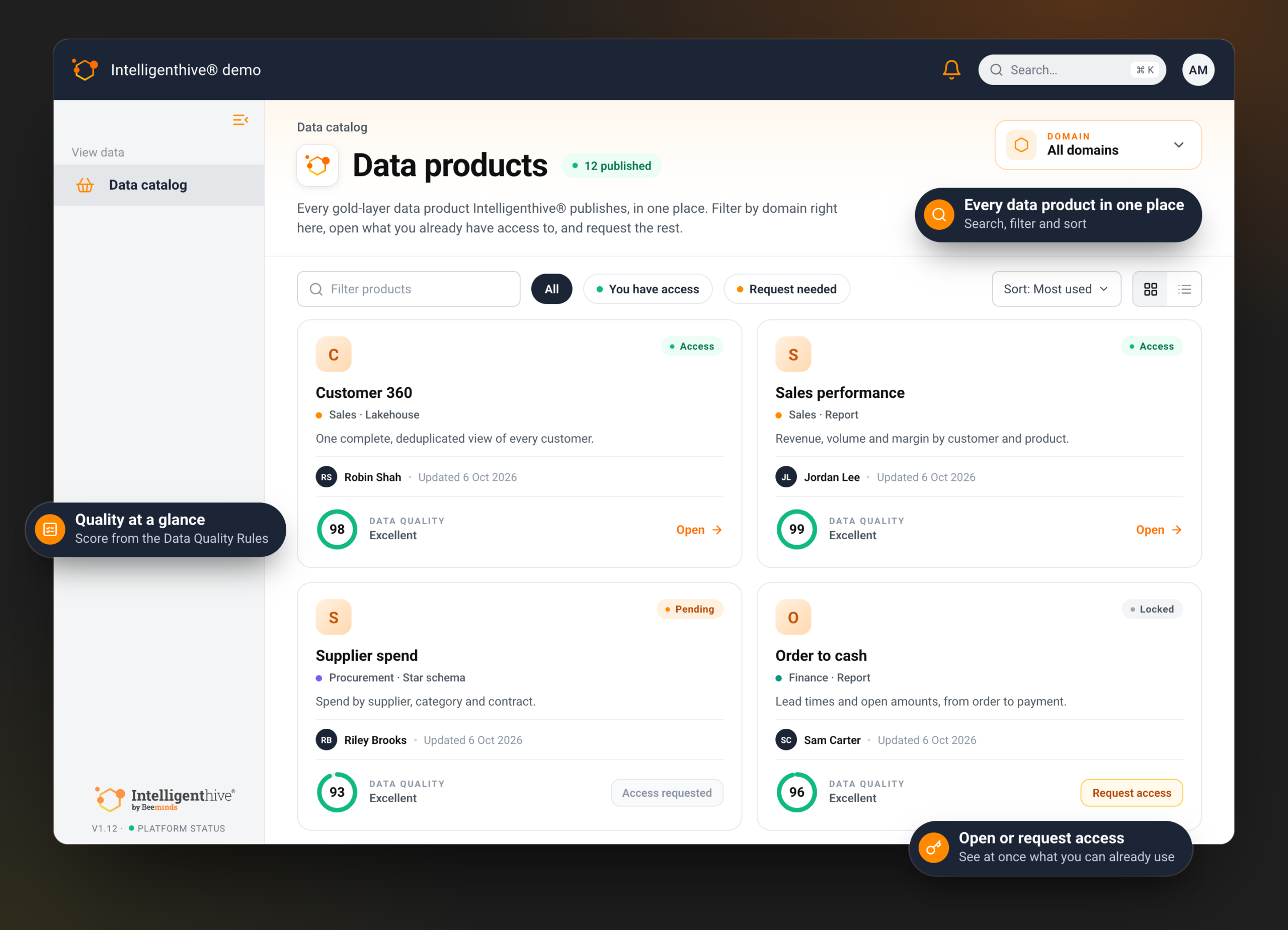
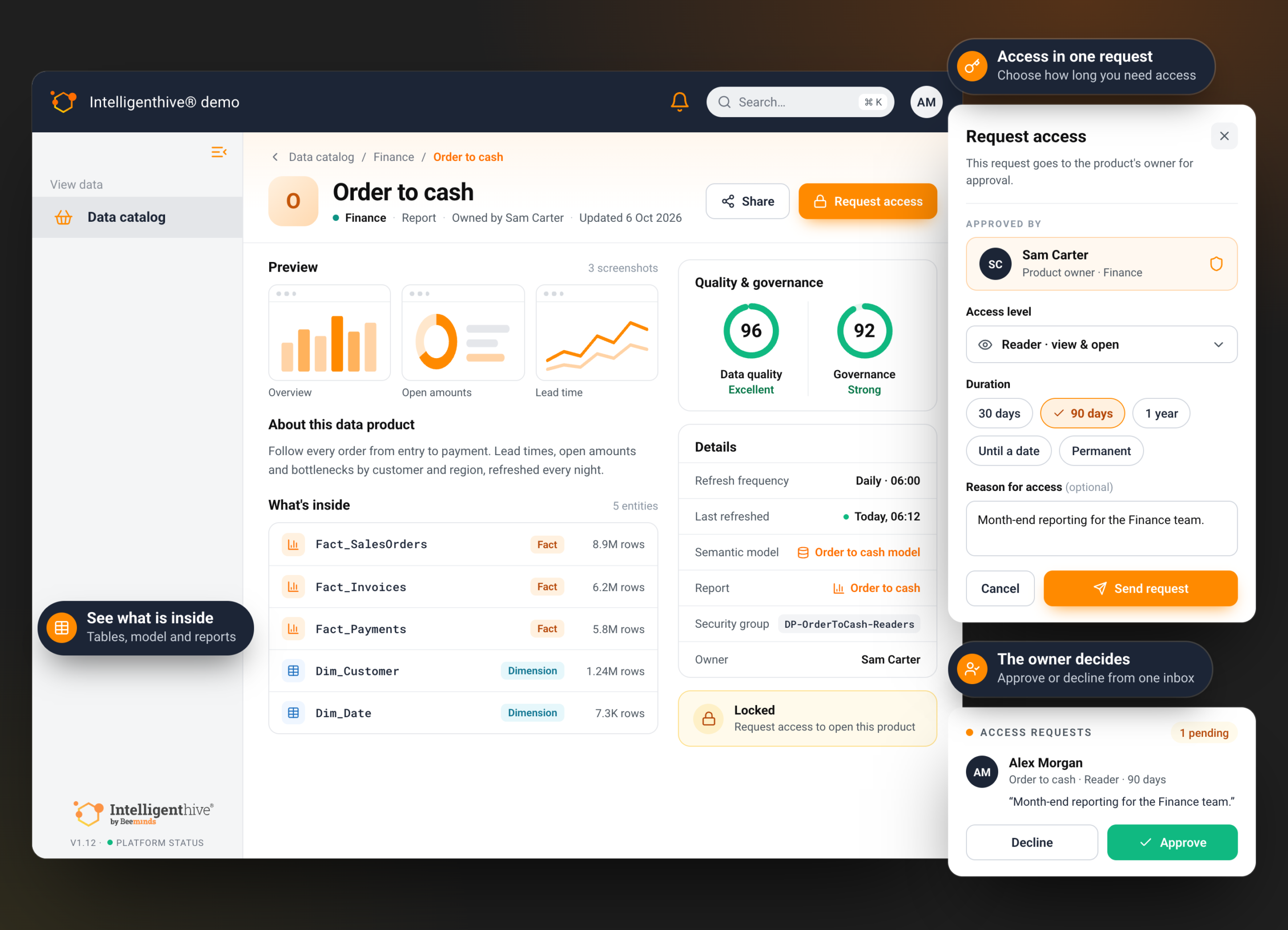
Purview had a catalog, but few end users felt at home in it. In the Intelligenthive®, the data catalog is a calm, clear storefront for every data product in your organisation. You give it your own brand, with your own logo and colours, and you decide who sees what. Every card shows straight away what is inside, how reliable it is and whether you can already open it.
Not sure exactly what you are looking for? Ask the catalog’s agent. It searches all your data products and points you in the right direction.
Requesting access, linked to Microsoft Entra ID
The feedback we heard most often, about Purview and about Fabric: anyone who finds a data product but has no access to it yet gets stuck. There was no good, integrated way to request access. So it became an email, a ticket or a quick message.
In the Intelligenthive®, you request access from the data product itself. You choose how long you need it and the owner decides. Once approved, the Intelligenthive® adds you to the data product’s readers group: a security group in Microsoft Entra ID that holds the permissions on the Fabric items. When your period ends, access expires by itself. So you always know who has access, until when and why.
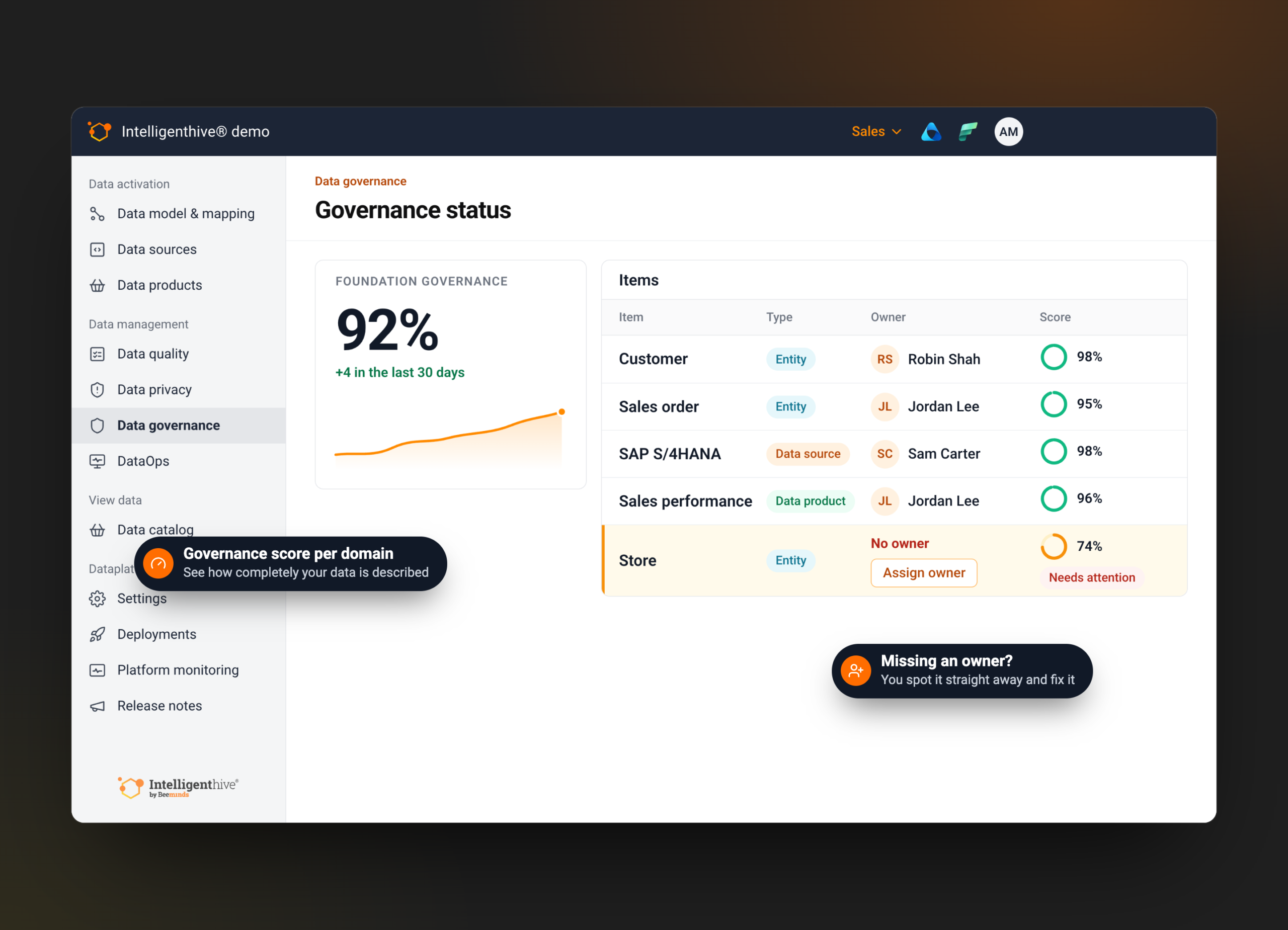
Governance score: how is your domain doing?
Governance only becomes concrete when you can measure it. The Intelligenthive® gives every data domain, every source, every entity and every data product a governance score. It shows how completely your data is described and whether there is an owner. You see the score per domain, the trend over the last thirty days and exactly which parts still need attention. Is an owner missing? Then you assign one on the spot.
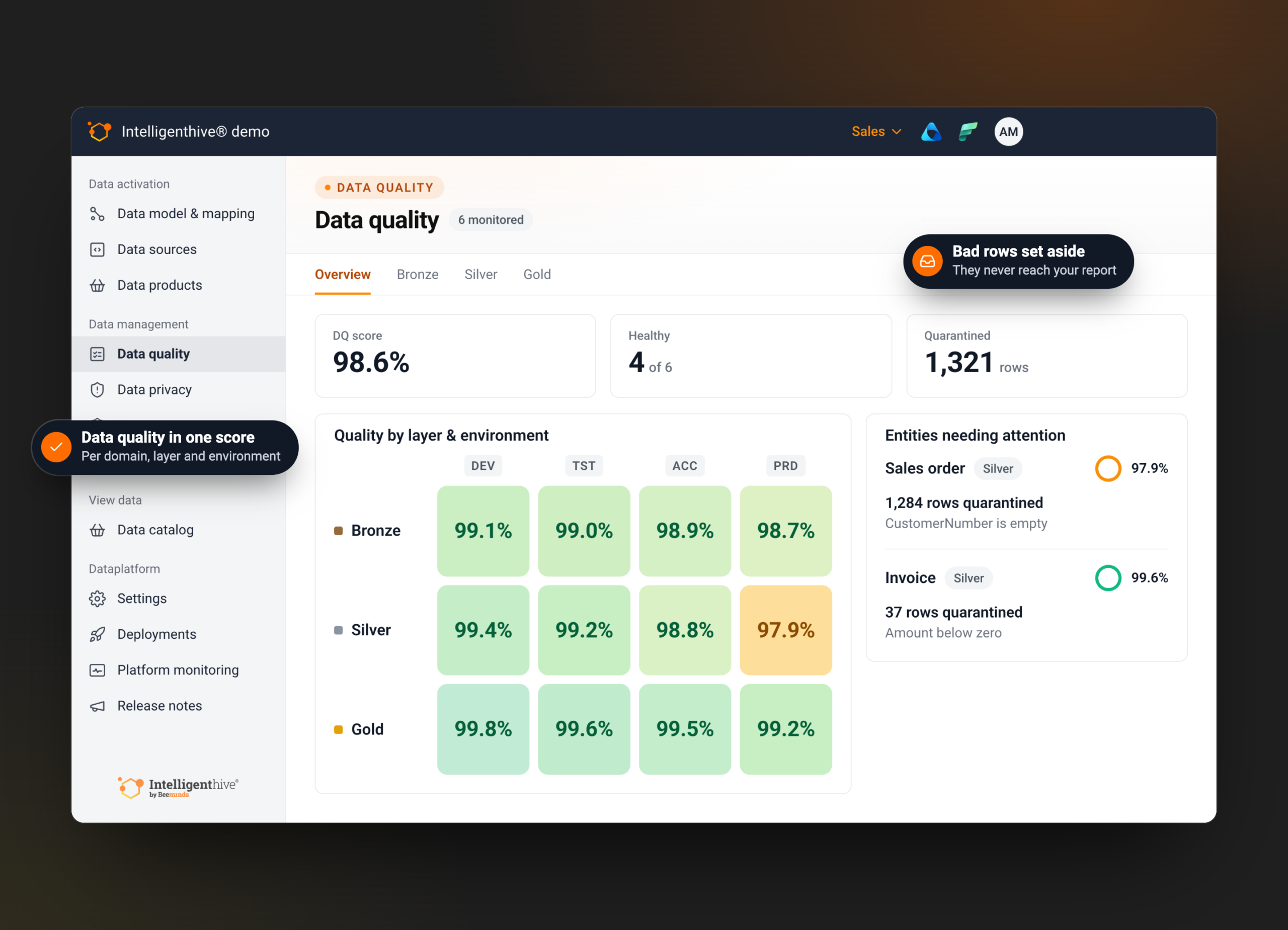
Data quality in one score, per domain and per data product
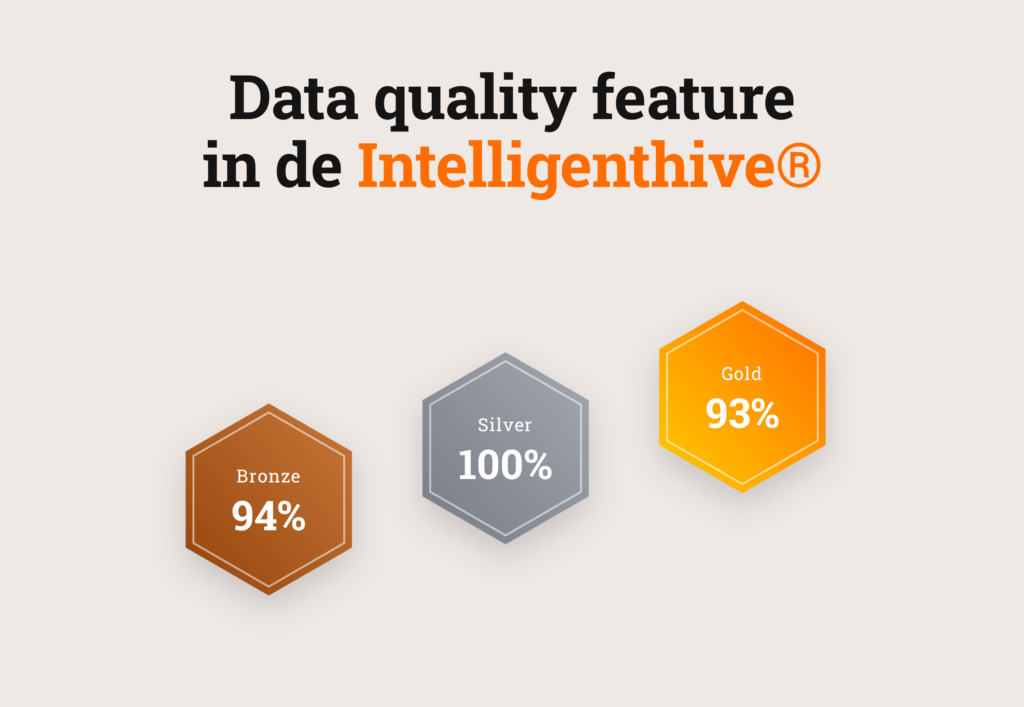
In the Intelligenthive®, quality rules run with every load. Bad rows go into quarantine and never reach your report. You see the result as a score: per domain, per layer and per environment. And end users see the score of every data product directly in the catalog. Nobody has to guess any more whether the figures can be trusted.
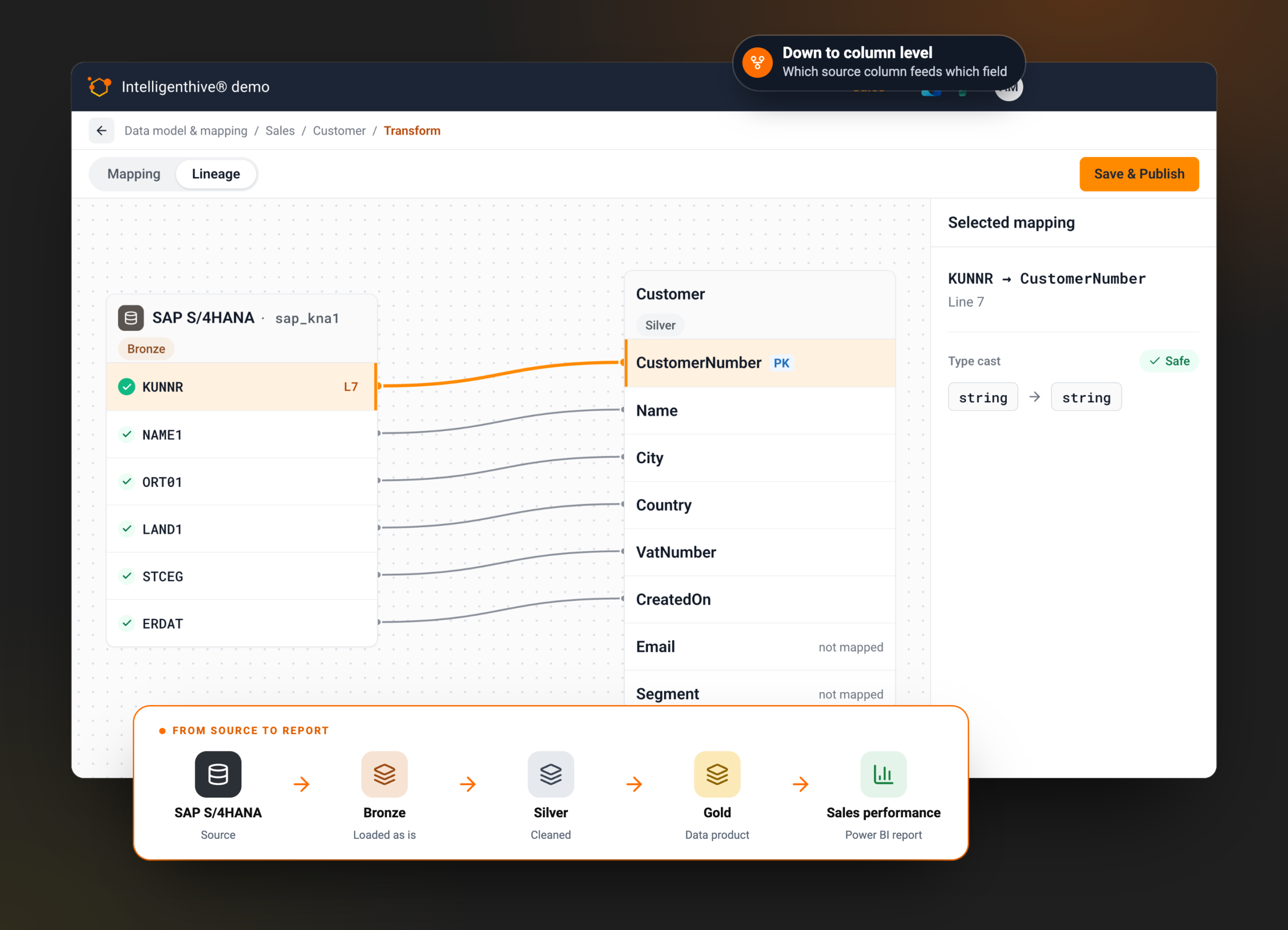
Lineage: from report back to source
Anyone looking at a report wants to know where the figures come from. In the Intelligenthive®, you see for every data product exactly which sources the data comes from, through Bronze, Silver and Gold, down to column level. Fabric shows lineage for the items it supports. Load your data in a more advanced way and that line often stops. The Intelligenthive® builds the pipelines itself and records what happens at every step. So the line from source to report stays complete.
One glossary for your whole organisation
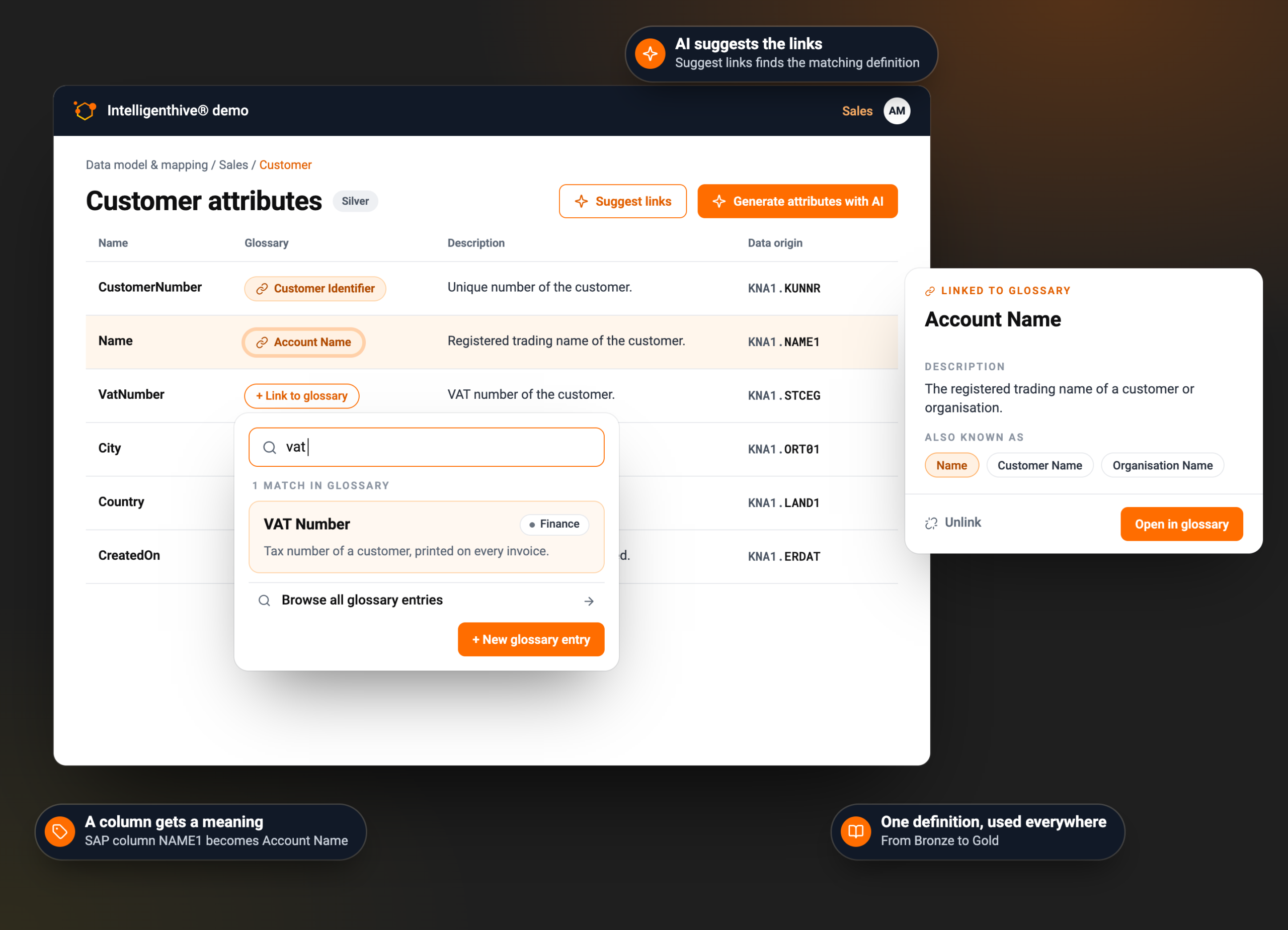
What exactly is net revenue? If every team has its own answer, reports never match. In the Intelligenthive® glossary, you record business definitions centrally, per domain and with synonyms. You link them to the attributes of your sources, entities and data products. That way, a cryptic SAP column such as NAME1 simply gets a name everyone understands: Account Name. And every definition shows up wherever the data is used.
AI does the groundwork. It reads your entire data model, from source to data product, and suggests definitions. It suggests the links too: for every column, the AI looks for the matching definition. You check them and adopt them in one click. The definitions are stored in the Intelligentmodel, and when the AI describes your data, it uses the words from your glossary.
Data privacy: not just labelling, but protecting
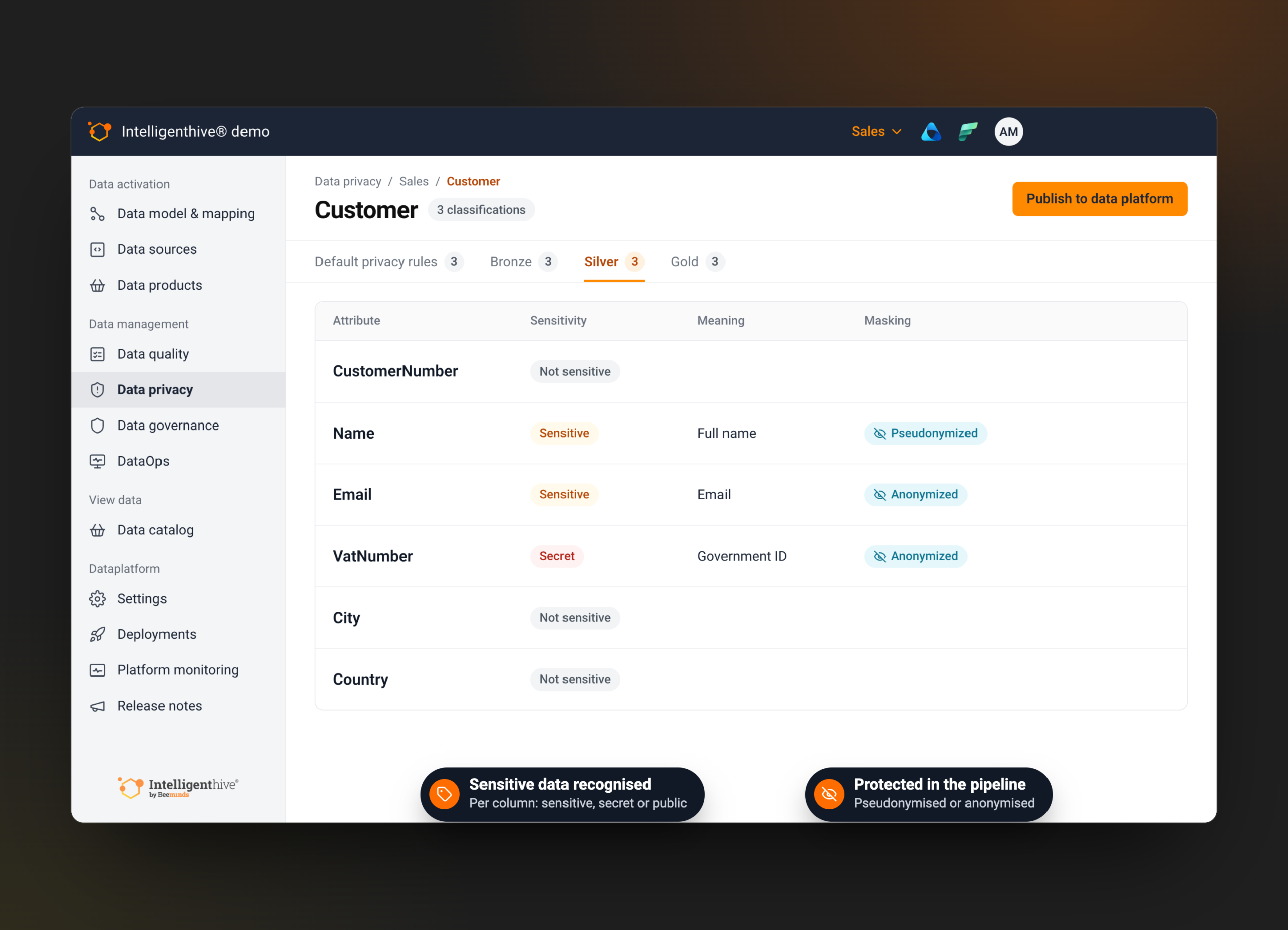
In Purview, you have long been able to mark which data is privacy-sensitive. But that is where it stopped. What happened to that data next was up to Fabric, and so up to you. In the Intelligenthive®, privacy has been part of the platform itself for years. Per column, you record how sensitive the data is and what it is: a name, an email address or a national ID number. AI helps recognise and classify privacy-sensitive data. And during loading, the pipeline pseudonymises or anonymises the sensitive columns before the data reaches your data products.
Making Fabric more powerful, together with our customers
All of these features grew out of user feedback, and we are extremely grateful to our customers for it. Their feedback makes the Intelligenthive® more complete, and with it Microsoft Fabric more powerful. Because that is what it is all about in the end: a data platform people actually use, because they can find, understand and trust their data.
And the rest of Purview?
We are phasing out, step by step, the parts of Purview Data Governance that the Intelligenthive® still uses today. Think of registering sources in Purview, forwarding lineage and the link with the Purview glossary. This comes with the regular releases, well before 12 November 2027. So you move to Microsoft Fabric seamlessly, and the Intelligenthive® takes care of it for you. Sensitivity labels and DLP stay in Purview and simply keep working.
Discuss your move with Stefan
share post