











Since the breakthrough of ChatGPT, Claude, and Gemini, artificial intelligence has become an integral part of the workplace. Employees use AI to write texts, summarize documents, generate code, or look up information more quickly. These applications fall under what we call generative AI: technology that creates new content based on existing knowledge and patterns.
Yet we’re seeing organizations take the next step and seek answers not only based on general knowledge, but also on their own business data. A sales manager wants to know why revenue is lagging. A CFO wants insight into margins. An operations manager wants to understand where delays in processes are occurring. That’s when the need for a different type of AI arises: the data agent.
For many organizations, this sounds like the next step in data-driven work. But if you look beyond the AI hype, you’ll discover that not every data agent delivers the same quality. Some agents provide surprisingly good answers. Others produce insights that sound logical but are factually incorrect. This raises an important question: What actually makes a data agent smart?
Why many data agents’ experiences fall short of expectations
Take a simple question like: “How many active customers do we have?”
To a human, that seems like a straightforward question. Not so for a data agent. What do we mean by an active customer? A customer who placed an order in the past month? In the past twelve months? Or only customers within a specific business unit?
Imagine that a new employee starts at your organization tomorrow. On his first day, he is granted access to all systems. He can open the CRM, view financial figures, and analyze reports. Technically speaking, he has access to the same information as an experienced manager.
Still, no one would expect him to be able to make strategic decisions right away. He isn’t familiar with the organization. He doesn’t yet understand the processes. He doesn’t know which definitions are used or what exceptions exist.
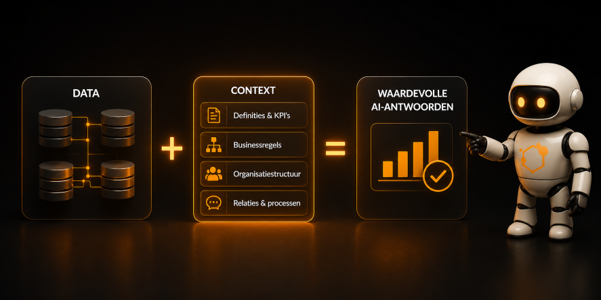
The data is available. The context is missing. And that is exactly what we see with data agents as well.
Why Context Is Crucial for AI Adoption
Traditional dashboards are designed for people. When a user sees a KPI, they often intuitively understand what it means. They are familiar with the organization, speak the same language as their colleagues, and know which definitions are used.
A data agent does not have that background knowledge. For AI, a KPI consists solely of data and metadata. If definitions are missing or business rules are not documented anywhere, the agent must interpret the data on its own.
This leads to a familiar pattern. The answers sound convincing, but upon closer inspection, they turn out not to be entirely accurate. Not because the technology is lacking, but because the context needed to understand the data correctly is missing.
That is precisely why the focus is shifting more and more from AI to the quality of the underlying data landscape.
Where data agents really add value
When data and context come together, that’s when the true power of data agents is realized.
We see particular potential in situations where users aren’t looking for a standard report, but for an answer to a specific question.
Consider, for example, a manager who notices that revenue has dropped and wants to immediately understand why. Instead of opening multiple reports and performing analyses themselves, a data agent can explore different perspectives and offer possible explanations.
We also see significant added value in more exploratory analyses. Users can ask questions that weren’t predefined and navigate the data in a natural way. This makes the data accessible to a much larger group of employees.
“Data agents are increasingly collaborating with other agents right from your workspace. An analytics agent identifies an opportunity, a CRM agent finds the right customers, and another agent immediately prepares a follow-up action. As a result, AI is shifting from a standalone tool to an active participant in business processes.”

A solid data foundation with Intelligenthive®
When definitions are missing, data sources contradict each other, or no one knows exactly how KPIs are calculated, AI won’t solve those problems. In fact, these issues often become more apparent because users ask the data directly and generate unreliable answers.
That is why successful AI does not start with AI itself, but with a solid data foundation in which data, definitions, and business knowledge are consistently documented. At Beeminds, we see that many organizations already have valuable data. What is often missing is the context needed to make that data reliably usable for AI.
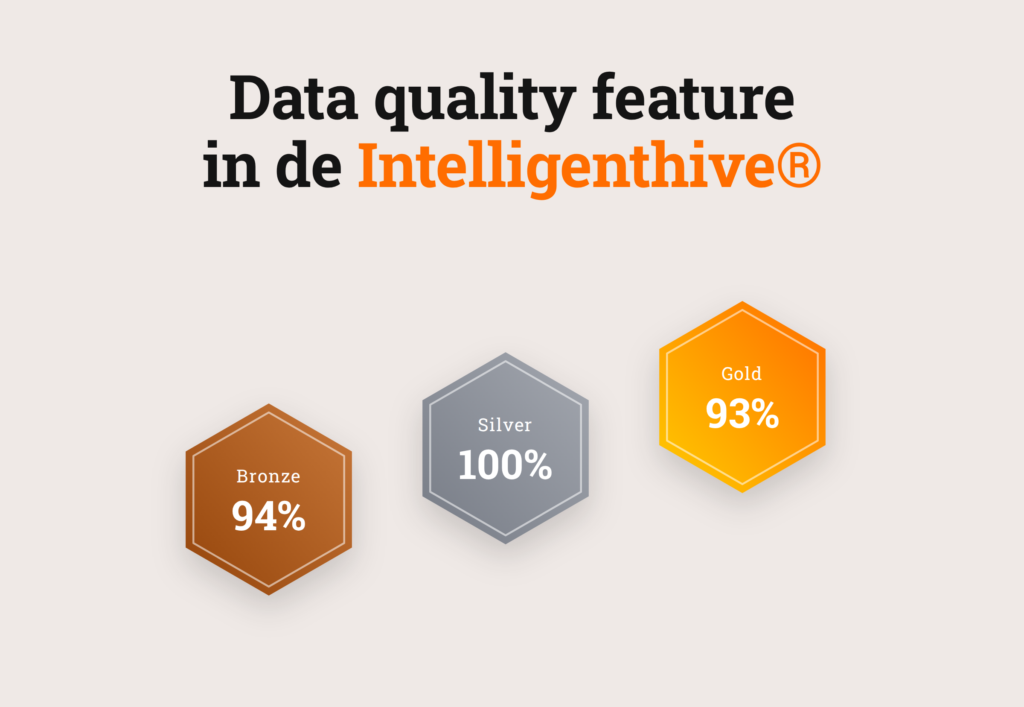
With Intelligenthive®, we bring together data, business rules, definitions, and relationships in a single central environment. This creates a foundation that is understandable not only to people, but also to AI.
As a result, a data agent transforms from a savvy intern with access to all systems into an experienced colleague who understands how the organization works. Not because the technology is getting smarter, but because the context needed to draw the right conclusions is now available.
Get started with data agents
Want to get started with data agents yourself? You can! In just one day, you’ll experience how AI analyzes data and learn how to create data agents that actually provide reliable answers.
Discover our hands-on training courses and sign up now!

share post