













“Thanks to the cooperation with Beeminds, we have laid down a solid data foundation for the entire organization, within the agreed scope and timing.”




“In five years, Samenwerkende Kinderopvang has grown into a bundle of 16 child care organizations nationwide. Each of these organizations had its own reporting system. A solid foundation for all data became a must-have,” says Sander van Yperen, Manager of Business Control & BI at Samenwerkende Kinderopvang.
Samenwerkende Kinderopvang is an organization that works every day to provide the best child care for children and their parents. Firmly rooted in the neighborhood, over 400 locations for daycare, preschool and out-of-school care offer every child in the Netherlands the finest opportunities for growth.
*Figures 2024
“Each label within Collaborative Child Care had its own practices and systems. Rapid growth created a clear question: what data will help us provide the best child care at each location?” says Sander. “Business control and BI was still in its infancy at many labels. That is precisely what made it interesting: there was a lot of room to build a solid and integral foundation for insight into pedagogical aspects, GGD inspections, staff planning and occupancy, absenteeism and satisfaction. Child care is people work. We wanted to unlock data as a basis for the right conversation about the quality of our care and what it takes to make that quality even better.”

The first dashboards were created in Excel, but Collaborative Child Care soon ran into limits here. “It was not possible to access data carefully and clearly,” says Sander. In addition, the different layers within the organization demanded different levels of information. So we needed something else.”
The wants and needs were clear:
“Thanks to the cooperation with Beeminds, we have laid down a solid data foundation for the entire organization, within the agreed scope and timing.”

Samenwerkende Kinderopvang oriented itself to several vendors and chose Beeminds. “What made the difference for us was that Beeminds’ knowledge goes beyond Microsoft Fabric,” says Sander. “There was a clear vision and methodology behind it: how to model data, go from source to reporting and how to keep that manageable. In addition, we experienced a strong partnership with Beeminds by really working together toward the same goal.”
Within weeks, Beeminds realized an organization-wide data platform with a data model. Reporting based on Intelligenthive® and Microsoft Fabric followed a few weeks later.
This was possible in part because of the approach taken:
“The workshops helped us work out the business model. It provided depth to really understand well from each other the way we look at our world. The most important question: how do locations, groups, children, staff, hours, inspections hang together in practice? That common ground provided pace and clarity later in the project. This is where the final data model emerged,” says Sander.
For Collaborative Childcare, it was important to combine sources that were previously separate. After activating the Intelligenthive®, within a few weeks several internal and external sources were linked, such as the systems for HR and planning and, for example, the National Register of Childcare (LRK). “Because of those links, we now see connections that previously remained invisible. In this way, the data allows us to better understand what is happening in practice.”
Beeminds also really challenged Collaborative Child Care,” Sander says. “In some cases it confirmed our chosen approach. In other cases, a critical look made it clear that adjustments were needed. That led to a better end result.”
Beeminds built the first layers and transformations. After that, the team of Collaborative Child Care increasingly took control. Beeminds’ role in the collaboration was more supportive.
Sander is clear about this: “Looking back, we went from launch to live at a fast pace. All previous reports were phased out on schedule. An important success factor was that we fine-tuned expectations at the front end, with extra attention to scope and risks.”
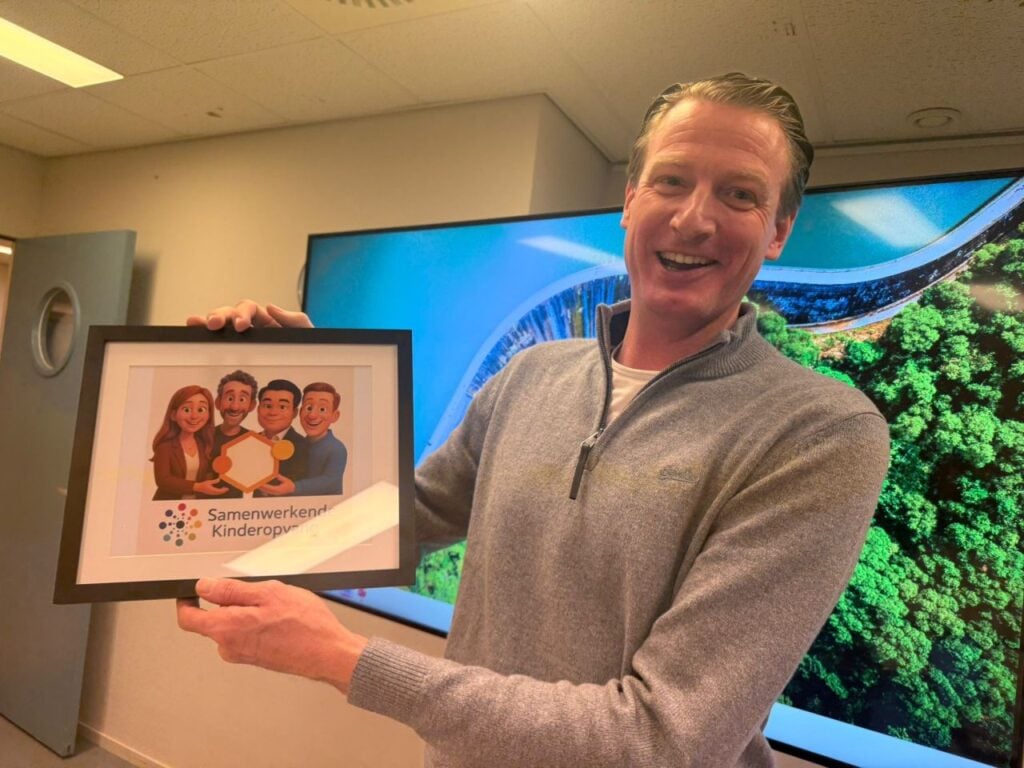
“To achieve our ambition, it is important to ask ourselves every day the question: what is going well and what could be better? Based on reliable and predictive data, we now have concrete tools to have the right conversation everywhere: from location to the boardroom.”

Sander notices the effect every day. “The data provides clear insight. The reporting frequency has greatly increased and better insight at every level. This gives us concrete tools to really manage our most important work processes thoroughly.”
Data is now better supported and utilized throughout the organization. Where previously forty to fifty people worked with reports, this now concerns about 250 people. The added value is in the use by colleagues in operations: location managers and planners who use the information to optimize processes and increase quality.”
One of the most important dashboards is about workforce deployment. Sander explains: “The dashboard provides insight into the future attendance of children. This enables us to anticipate this with staff deployment. If we look ahead, you can now see, for example, if in two weeks one employee is over-scheduled in a group. Then the question to the location manager is: do you really need it? The dashboard allows us to optimize staff deployment. Especially in a tight labor market, it is important to deploy labor capital as well as possible.”
“Insight does not automatically mean an adjustment in actions or behavior in the workplace. But that is ultimately the added value of the data.” says Sander. “We have therefore set up a plan-do-check-act cycle in which the dashboard is central. That delivers visible results. The use of external staff has decreased substantially as a result.”

For me, the difference is in the partnership. No we-they, but taking responsibility together and moving forward together.”
As an organization with the ambition to provide the best childcare for as many children as possible in as many places as possible in the Netherlands, the use of reliable and predictive data is an important tool. Besides reports and dashboards, Samenwerkende Kinderopvang is investigating the added value of Data agents to support employees in their work and with ad hoc questions, based on their own data.
“This data foundation we have established allows us to develop different reports. It also gives room to experiment with AI. The next step is to explore how a Data agent can help us work with data in an interactive way to better understand what is really happening.”

share post